»Sinne|Sinn: Geräusch – Musik – Geräuschmusik«
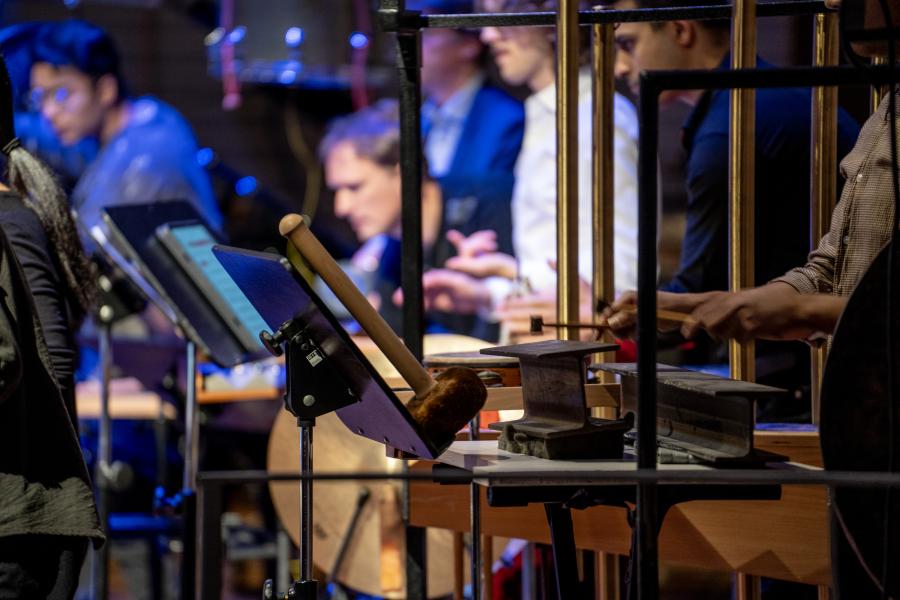
Sound art festival with symposium
With eight concerts, installations and sixteen presentations, the symposium »Sinne|Sinn: Geräusch – Musik – Geräuschmusik« deals with music in which sounds have been incorporated as a natural part of music. The weekend is the second in a series of three symposia with the title »Sinne|Sinn«, a network project of the MHL, the Christian-Albrechts-University Kiel, the Muthesius Kunsthochschule Kiel and the Forum für zeitgenössische Musik e.V.
The presentations on different topics of sound art are held by training staff of the MHL and guests like Hartmut Rosa (Jena), Helga de la Motte-Haber, Martin Kaltenecker (Paris), Marko Ciciliani (Graz), Michael Maierhof (Hamburg), Anothai Nitibhon (Thailand), Axel Dörner, Max Eastley, Kathrin Kirsch (CAU Kiel) and Sven Lütgen (Muthesius Kunsthochschule). The broad range of approaches include the analysis of works, thoughts on performance practice, insights into composers and performers in their creative work, the depiction of developed techniques, sociological classification and pedagogical aspects.
The eight concerts of the symposium are supported in large part by the training staff and students of the MHL (including the MHL-Instant Composing Ensemble, the MHL-Ensemble for Neue Musik lead by Maximilian Riefer and the drum class of Prof. Johannes Fischer). It is furthered by guest appearances by the Ensemble Klangrauschen and other guests. The program consists of standard pieces of sound art such as Lachenmann's ensemble compositions »Mouvement - vor der Erstarrung«, Stockhausens »Mikrophonie I« for tamtam, microphone, and filter or Varèses »Ionisation« for 13 drummers. It will also include music by and with composers from the MHL (Danksagmüller, Fischer, Goldford, Hein, Kim, Korte, Lemke, Mansouri, Rosenberger), by guests of the symposium (Ciciliani, Dörner, Eastley, Maierhof, Nitibhon, Yip) and compositions by Aperghis, Bauckholt, Bedrossian, Cage, Fure, Oliveiros, Pisaro, Alexander Schubert and Sciarrino.
During the symposium, there will be installations in the vicinity of the Große Saal and the Kammermusiksaal; the interactive installation »WHY FRETS? - Tombstone« by Marko Ciciliani as well as works by MHL students.
Why is the topic »Sound Arts« so virulent?
While Arnold Schönberg quotes the »lieber Augustin« in his second string quartett (1907/08) to say goodbye to the tonal world, the same work appears only as a rhythmical skeleton laced with sounds. Not only is the good old tonality thus abandoned; it also proposes the idea that the composer is only setting notes and that music consists primarily of the organisation of said notes. Lachenmann realises something quite important at this point already - also concering his own work: the emancipation of sound and the departure into unexplored parts of new tonal worlds challenges the inventions of its own networks and adequat forms just as much as the listening of that music.
This development started as early as the start of the 20th century; think of the Italian futurists with their new instruments inspired by the sound scapes of big cities, the Intonarumori, for which they composed many works in the 1910s and 1920s. Composers saw the potential of percussion instruments that had been used solely for »decorative« purposes up to that point. Percussion became an isolated, autonomous formation of instruments as, for example, Edgar Varèse's »Ionisation« (1929-31) for 13 drummers show. »Everything that can be heard can be utilised« said Walter Ruttmann 1929 and used the possibilities for recording, modification and montage to create an early audio example; »Weekend« explores possibilities of musically putting together seemingly unrelated sounds from day-to-day life.
This musicalising of recorded sounds was developed by the »Musique concrète« and has been refined and adapted continuously in different playing techniques of fixed media composition in accordance with the development of studio technology. In 1940, John Cage asked that the instruments for his »Living Room Music« be everyday items that can be found in every household, and, during a performance of »4’33’’« (1952), declared that everything that could be heard was part of the work. Soundscapes and field recordings address the musical value of sounds that can be heard in nature as well as in city life. The development of live-electrontic opportunities enhanced the world of instruments. It leads to a completely new, unheard-of and complex sound music, demanding new forms of music notation. An excellent example for this is »Mikrophonie I« (1964) by Karlheinz Stockhausen. New instruments are invented or created during experimental reconstruction of high- or explicitly low-priced and oftentimes electronic devices (circuit bending). The leftovers - the clicking, the whining, the rattling; the collateral damage of electrical sound transformation - that was previously surgically removed from the final product, is now assigned its own value and considered part of the musical components.
Sound has changed contemporary music on many levels and is still considered a driving force of new developments. The topic »sound - music - soundmusic« is thus a topic of intense topicality in the current discourse of music and aesthetics.
Though in direct contact with the listeners, sound music seems to block all scientific and intellectual dealings. Tools oriented towards the traditional musical composition are next to useless. Many scores do not show notation and sound but the process of making certain sounds. In fixed media, there is no score whatsoever, and in live electronics, the notation includes only practical orders.
It is due to that, specifically, that the subject of sound music is suited to post-hermeneutical approaches of interpretation. Every work poses a challenge to the listeners to find specific touching points and perceive resonances. The task and responsibility of our symposium is to find categories based on the experienced performance which help understanding a specific work, then to verbalise them, translate the experience into a playable score to then be able to discuss if it would be possible to make tangible statements on the work.
Through the historical development and the diversity of the kinds of sound art, there are many touching points with other arts as well as social sciences. In the symposium, we try many different approaches. Interpretational deciphering and designing of significant works, or the gathering of new experiences by dealing with composition and improvisation. Witnessing many concerts and installations, soundwalks and speeches. The lectures include renowned specialists in their specific fields of study including sound arts in general and those specific to composers and works who engage in the presented discourse. Discussion forums will provide opportunities to connect the findings with the experience of the artists.
Programme
FR / 20 / OCT / 23
- 10.00 - 12.00 o'clock / MHL / Kammermusiksaal
Sound music: part I of the presentations
10 o'clock / Opening with Prof. Dr. Bernd Redmann, president of the MHL
10.15 o'clock / Welcoming speech by project leader Prof. Sascha Lino Lemke
10.30 o'clock / Martin Kaltenecker: »Musik und Geräusch – eine französische Perspektive«
11.15 o'clock / Nicola L. Hein: »Kybernetisches Hören / Improvisation zwischen Mensch und Maschine«
- 12.30 o'clock / MHL / Kammermusiksaal
Sound art festival I: Beyond Keys
The first midday concert of the symposium »Sinne|Sinn: Geräusch - Musik - Geräuschmusik« is organised by the musicians' collective around Ariadne Dalatsi, Jorma Marggraf and Adrian Thieß which first rose to prominence with media-wide staged concerts like the »Exonauten«-project in this year's Brahms Festival, and the programme »α-dis-τρωη« awarded the first prize at the third Possehl Competition "Neue musikalische Aufführungskonzepte" (new concepts of musical performances). This is what they write about the new programme: »Keys are my reality. They are pressed and a whole body is set into motion. The potential of this body is what must be researched. On the search for new tonal concepts, a concert about continually finding something new in a body we thought we already knew is developed. A search connecting the past with the future.«
- 13.00 - 13.45 o'clock / MHL / Kammermusiksaal
Sound music: part II of the presentations
13 o'clock / Oliver Korte: »Ein – Aus. Atmen mit Fausto Romitelli.«
- 15.00 - 15.30 o'clock / MHL / Upper Lounge
Performance »Sweet Noises«
- 15.45 - 18.30 o'clock / MHL / Kammermusiksaal
Sound music: part III of the presentations
15.45 o'clock / Johannes Fischer: »All you can hear is sound - Geräusche sammeln als künstlerische Praxis«
17 o'clock / Sascha Lemke: »Hijacked! - Zu Mauro Lanzas Streichquartett 'The 1987 Max Headroom incident'«
17.45 o'clock / Helga de la Motte-Haber: »Das Geräusch«
- 20 o'clock / MHL / Großer Saal
Sound art festival concert II: Electronic and intermedia composition
At the first evening concert of the symposium »Sinne|Sinn: Geräusch - Musik - Geräuschmusik« the MHL studio for digital creation presents three sets all about electronic and intermedial composition. The first set is organised by the transmedial duo »Transsonic« (Nicola L. Hein & Viola Yip), creating immersive and location-specific performances and installations overriding the oscillations of light and sound. Both musicians focus on the ontology of sound and the question how music may be transformed beyond their material. Their work for the artistic research project Transsonic includes researching light as expanded musical material and the development of an aesthetic between light and sound as equal, though dialectical, musical materials. In his performance »Why frets? - Downtown 1983« (2021-22), the second set of the evening, Marko Ciciliani tells the fictive story of the electrical guitar. The work is based a short work for three guitarists (recorded with Nico Couck, Nele de Gussem and Alex Tentor), which is presented as a documentary filmed in 2083 on a concert that took place 100 years before, in 1983, in Downtown Manhattan. During the performance the video is shown three times, all gradually more alienated. The third set is presented by Nicola Hein and her trio partners Max Eastley (kinetic sculptures) and Axel Dröner (trumpet). All three will also present lectures on their own work during the symposium.
- 22.30 o'clock / MHL / Großer Saal
Sound art festival concert III: Asleep? - A Late Night Concert
The friday-night-concert of the symposium »Sinne|Sinn: Geräusch - Musik - Geräuschmusik« begins with a collective "sound meditation" as per Pauline Olivero's »Sonic Meditations #5. Native« (1971), a sound walk that will lead the audience to the Große Saal. There, the MHL Instant Composing Ensemble under Max Riefer will end the first day with a performance of Michael Pisaro's »asleep, desert, choir, agnes« (2016) for 22 musicians and electronics.
SA / 21 / OCT / 23
- 10.30 - 12.30 o'clock / MHL / Kammermusiksaal
Sound music: part IV of the presentations
10.30 o'clock / Sven Lütgen: »Kleines Alphabet vom Knistern und Rauschen«
11.45 o'clock / Michael Maierhof: »N.N.«
- 12.30 - 13.00 o'clock / MHL / Kammermusiksaal
Sound art festival concert IV: quartet for objects with engines and microphones - Michael Maierhof and the Klangrauschen Ensemble
After an introduction to his special sound research and personal composing practice by composer Michael Maierhof from Hamburg, the audience may experience a performance of his work "oscillating systems, D - quartet for objects with engines and microphones" (2018-20) by the Klangrauschen Ensemble. The four musicians play specially constructed instruments made of sponge clothes, paper, tuning forks, plastic rulers and cling film with primed electronic toothbrushes. Enhanced by separate amplification through four amplifiers, a transparent and immersive soundscape is created. The unusual instruments and the clever use of microphones with proximity effect create an unconventional and extremely bodily concert experience. The performance is realised by the »Forum für zeitgenössische Musik« Kiel, a partner of the Sinne|Sinn-symposia-trilogy.
- 14.30 - 16.45 o'clock / MHL / Kammermusiksaal
Sound music: part V of the presentations
14.30 o'clock / Hartmut Rosa: »Listening/Hearing: Was Geräusche zur Musik macht«
15.15 o'clock / Max Eastley: »N.N.«
16 o'clock / Marko Ciciliani: »Noise im intermedialen Kontext«
-
18 o'clock / MHL / Großer Saal
Sound art festival concert V: ...after the ossification?
At the Saturday night concert of the symposium, musicians of the MHL perform significant "classics" of compositions by sound as well as two contemporary of this genre. Arnold Schönberg cited the "lieber Augustin" in his second string quartet (1907/08) to say goodbye to the 'old' tonal world. So too has Helmut Lachenmann cited the same work in the middle part of his ensemble piece »Mouvement – vor der Erstarrung« (1983/84), though only as a rhythmical skeleton made of sounds. Not only does he break with the good old tonality but also with the idea that the primary function of a composer is the putting down of notes and that music consists primarily of organising notes. Lachenmann has realised that the emancipation of sound and the departure to the world of new tonality challenges the invention of their own networks as much as the listening of said music.In honour of Lachenmann's compositional landmark, the concert includes other important works of sound composition. In "Ionisation" (1929-31), Varèse introduces its instrumentation of thirteen drummers an independent sound device. With strategically and musically utilised sirens, he brings city life into his art. In his »Living Room Music« (1940), John Cage shows that even simple everyday items found in every living room may be turned into musical instruments. Stockhausen's »Mikrophonie I« (1964) introduces us to the vast variety of the sound of a single Tam Tam played by six (!) individual players with different materials. The sound is then projected by artistically moved microphones, filters and volume control buttons. »Come vengono prodotti gli incantesimi?« (1985) is one of the many works of Sciarrino that revolutionised the writing for transverse flutes and enhanced the spectrum of sounds for this specific instrument greatly. Those works, today considered true classics, are commented by two contemporary compositions. Katharina Rosenberger, MHL professor for composition, who will also be part of the speakers for the symposium, explores the "soundiness" of her trio and transformes the live sound of instruments by use of effect pedals in »Wälzung« (2023). Also part of the programme is Franck Bedrossian, a composer of the French »Saturismus« dedicated to the surfeited sound and the composition of untenable densities.
Whether we're currently in a state of ossification as Lachenmann proposes in his work "Erstarrung" or in a phase of "touristic analysis" of the first concert experiences as he has criticised time and again, or if we have indeed already shaken off the ossification - that is something you will have to determine for yourself.
- 22 o'clock / MHL / Canteen
Sound art festival concert VI: »pulse generator: roh und gekocht«
The second night of the symposium will be concluded with a jam session of the duo Johannes Fischer (percussion) and Franz Danksagmüller (electronics) and one or two drinks at the canteen.
SUN / 22 / OCT / 23
- 10.30 - 12.00 o'clock / MHL / Kammermusiksaal
Sound music: part VI of the presentations
10.30 o'clock / Christiane Tewinkel: »Wie klingt Kunst, wie der Verwaltungsapparat? - Sergej Newskis Pazifik Exil (2016) für sechs Stimmen und Live-Elektronik nach einem Text von Michael Lentz«
11.15 o'clock / Kathrin Kirsch: »Geräusch-Musik-Wissenschaft: Überlegungen zu Karlheinz Stockhausens Mikrophonie I«
-
12.30 - 13.00 o'clock / MHL / Kammermusiksaal
Sound art festival concert VII: »Das esioN rumort des nachts« - participation activityThe Sunday midday concert of the symposium, a participation activity for children and audience, is organised by students of the music education programmes under Marno Schulze. There, they will research the esioN: »Do you know the esioN? We were the ones who discovered it. Some animals are nocturnal, some diurnal. But the esioN is soundurnal. At night when Uncle Luigi begins to snore loudly is when it stirs. We have researched its activities. It reacts in many different ways to many different sounds. Sometimes it moves to them; like sound dancing! Sometimes it will accompany them with its very own buzzing, whirring and whining. We haven't yet been able to determine according to what exactly it goes about its life in the short time since the discovery of the esioN. That is why our meeting it will be all the more significant and might even lead to wholly new discoveries.«
- 13.15 - 14.45 o'clock / MHL / Kammermusiksaal
Sound music: part VII of the presentations
13.15 o'clock / Axel Dörner: »Erweiterte Spieltechniken auf der Trompete und Live-Sampling«
14 o'clock/ Andreas Dorfner: »'Vieles ist von selbst' oder 'Vom Eigenleben der Klänge. Fabula rasa' (1964) von Johannes Fritsch als Bericht aus der 'Endphase der sogenannten sauberen Elektronischen Musik'« -
17 o'clock / MHL / Großer Saal
Sound art festival concert VIII: Final Noises
The final concert of the symposium is a varied programme including works of composers of the MHL. Goeun Kim explores the sound palette of the contrabass, Payman Mansouri deals with the murder of Jina Mahsa Amini by the Iranian "morality police". Louis Goldford's string quartet score is inspired by a computer analysis of language and other sounds. Oliver Korte's composition has a drummer encrypting secret messages. In Sascha Lemke's »Albumblätter(er)«, a performance of turning over pages developing over the scratching of a 'sound skeleton' of waltz by Brahms, and the amplified mechanical sounds of a grand piano creating a parody of Schubert's »Marche militaire«, the concert is transformed into an old vinyl recording and the score, in turn, into the pages of a Rilke poem, themselves turning into instruments. In the corporeal perfomative "LaPlace Tiger" by Alexander Schubert who lead the electronic studios of the MHL from 2016 to 2021, the perfomer generates immersive live-electronic sounds and live-video feed through the playing of a drumset and sensors placed on the arms that register gestures. Also part of the programme is Carola Bauckholt's »Geräusche« ("Sounds") and Ashley Fure's »zitternde Lunge« ("trembling lungs") in which a subwoofer makes different objects laid on its membrane 'sing'. Composer Anothai Nitibhon, who will already be known to guests after his lecture at the symposium, will stage one of his ensemble works. The evening will be opened by a duo of Aperghi's where the performers' bodies become their instruments.Concert programme
- Georges Aperghis (*1945): »Retrouvailles Nr. 1« (2010)
- Louis Goldford (*1983): »Presto from Four possible čočeks« (2014)
- Payman Mansouri (*1984): »Jina« für Ensemble
- Carola Bauckholt (*1959): »Geräusche« (1992) für zwei Spieler
- Oliver Korte (*1969): »Epigramm - Kryptogramm - Piktogramm« (2017) für einen sprechenden Trommler
- Dennis van Rooyen: »Improvisation on Raw Instinct« (2023)
- Sascha Lino Lemke (*1976): »Albumblätter(er)« - 4 Fantasiestücke für Klavier zu vier Händen und Elektronik (2018)
- Ashley Fure (*1982): »Shiver Lung 2« (2017) for solo percussion and electronics
- Alexander Schubert (*1976): »Hello« (2014) für Ensemble und Elektronik
Musicians
- Olga Wegner (Contrabass)
- Jennifer Hymer & Bernhard Fograscher (piano duo)
- MHL-Ensemble für Neue Musik
- Max Riefer (director)